 |
Summer Safety |
Summer Weather Safety and Survival
Summer Safety Rules
Your National Weather Service Forecast
Office in Norman will usually initiate alert procedures when
the daytime heat index is expected to exceed 105°F and the
nighttime temperature remains at 80°F or more for at least
two consecutive days. This will typically result in a Heat
Advisory being issued for parts of the area.
What To Look For and Actions To Take
The Symptoms of
Heat Disorders...
|
Heat Disorder |
Symptoms |
First Aid |
|
Sunburn |
Skin redness and pain, possible swelling, blisters, fever, headaches. |
Take a shower, using soap, to remove oils that may block pores preventing the body from cooling naturally. If blisters occur, apply dry, sterile dressings and get medical attention. |
|
Heat Cramps |
Painful spasms usually in leg and abdominal muscles. Heavy sweating. |
Firm pressure on cramping muscles or gentle massage to relieve spasm. Give sips of water. If nausea occurs, discontinue. |
|
Heat Exhaustion |
Heavy sweating, weakness, skin cold, pale and clammy. Weak pulse. Normal temperature possible. Fainting, vomiting. |
Get victim to lie down in a cool place. Loosen clothing. Apply cool, wet cloths. Fan or move victim to air-conditioned place. Give sips of water. If nausea occurs, discontinue. If vomiting occurs, seek immediate medical attention. |
Heat Stroke
(Sun Stroke) |
High body temperature (106+). Hot, dry skin. Rapid, strong pulse. Possible unconsciousness. Victim will likely not sweat. |
Heat stroke is a severe medical emergency. Call 9-1-1 or emergency medical services or get the victim to a hospital immediately. Delay can be fatal. Move victim to a cooler environment. Try a cool bath or sponging to reduce body temperature. Use extreme caution. Remove clothing. Use fans and/or air conditioners. DO NOT GIVE FLUIDS. |
You can help yourself and others avoid experiencing the HEAT DISORDERS (above) by following these safety rules.
Thinking About Yourself
- Avoid the Heat. Stay out of the heat and indoors as much as possible. Spend time in an air conditioned space. Only two hours a day in an air-conditioned space can significantly reduce the risk of heat-related illness. Shopping malls offer relief if your home is not air-conditioned. If air conditioning is not available, stay on the lowest floor out of the sunshine. Remember, electric fans do not cool, they just blow hot air around.
- Dress for the heat. Wear loose-fitting clothes that cover as much skin as possible. Lightweight, light-colored clothing that reflects heat and sunlight and helps maintain normal body temperature. Protect your face and head by wearing a wide-brimmed hat. Avoid too much sunshine. Sunburn slows the skin's ability to cool itself. Use a sunscreen lotion with a high SPF (sun protection factor) rating.
- Drink FOR the Heat. Drink plenty of water and natural juices, even if you don't feel thirsty. Even under moderately strenuous outdoor activity, the rate your body can absorb fluids is
less than the rate it loses
water due to perspiration. However, if you have epilepsy or heart, kidney, or liver disease; are on fluid-restrictive diets; or have a problem with fluid retention should consult a doctor before increasing liquid intake.
- Do not drink IN the Heat. Avoid alcoholic beverages and beverages with caffeine, such as coffee, tea, and cola. Alcohol and caffeine
constrict blood vessels near the skin reducing the amount of heat the body can release. Although beer and alcohol beverages appear to satisfy thirst, they actually cause further body dehydration.
- Eat for the Heat. Eat small meals more often. Avoid foods that are high in protein because they increase metabolic heat. Avoid using salt tablets, unless directed to do so by a physician.
- Living in the Heat. Slow down. Reduce, eliminate, or reschedule strenuous activities such as running, biking and lawn care work when it heats up. The best times for such activities are during early morning and late evening hours. Take cool baths or showers and use cool, wet towels.
- Learn the symptoms of heat disorders and know how to give first aid.
Thinking About Others
- Do not leave children in a closed vehicle,
even for a few minutes. This is a "No-Brainer".
Temperatures inside a closed vehicle can reach
140°F-190°F degrees within 30 minutes on a hot, sunny
day. However, despite this common sense rule, deaths
from heat occur almost every Summer when someone leaves
their child in a closed vehicle.
- When outdoors, protect small children
from the sun, their skin is sensitive.
- Help your pets keep their cool. It
will "feel" as hot for them as it will for you. As with
children, do not leave your pets in a closed vehicle. Be
sure your animals have access to shade and a water bowl
full of cold, clean water. Dogs don't tolerate heat well
because they don't sweat. Their bodies get hot and stay
hot. During summer heat, avoid outdoor games or jogging
with your pet. If you would not walk across hot,
sunbaked asphalt barefoot, don't make your dog walk on
it either. (Dogs can also get blisters on their paws
from hot pavement.)
Learn the symptoms of heat
disorders and know how to give first aid

Heat
is one of the leading weather-related killer in the
United States, resulting in hundreds of fatalities
each year. In the disastrous
heat wave of 1980, more than 1,250 people died.
In the
heat wave of 1995
more than 700 deaths in the Chicago area were
attributed to heat, making this the deadliest
weather event in Chicago history. In August 2003, a
record heat wave in Europe claimed an estimated
50,000 lives.North American summers are
hot; most summers see heat waves in one or more
parts of the United States. East of the Rockies,
they tend to combine both high temperatures and high
humidity, although some of the worst heat waves have
been catastrophically dry.
NOAA's Watch, Warning, and Advisory
Products for Extreme HeatEach
National Weather Service
Forecast Office issues the following
heat-related products as conditions warrant:
-
Excessive Heat Outlooks:
: are issued when the
potential exists for an excessive heat event in
the next 3-7 days. An Outlook provides
information to those who need considerable lead
time to prepare for the event, such as public
utility staff, emergency managers and public
health officials. See the
mean heat index and probability forecasts
maps.
-
Excessive Heat Watches: are
issued when conditions are favorable for an
excessive heat event in the next 24 to 72 hours.
A Watch is used when the risk of a heat wave has
increased but its occurrence and timing is still
uncertain. A Watch provides enough lead time so
that those who need to prepare can do so, such
as cities officials who have excessive heat
event mitigation plans.
-
Excessive Heat Warning/Advisories
are issued when an excessive heat event is
expected in the next 36 hours. These products
are issued when an excessive heat event is
occurring, is imminent, or has a very high
probability of occurring. The warning is used
for conditions posing a threat to life. An
advisory is for less serious conditions that
cause significant discomfort or inconvenience
and, if caution is not taken, could lead to a
threat to life.
How Forecasters Decide Whether to Issue
Excessive Heat Products
How Forecasters Decide Whether to Issue
Excessive Heat Products
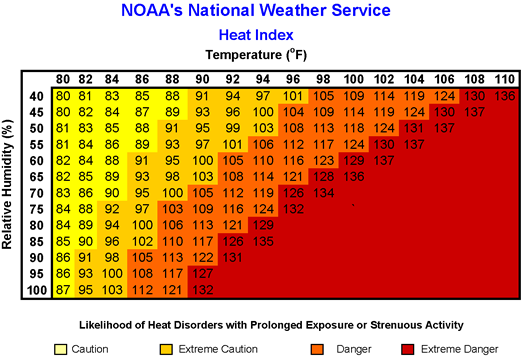
NOAA's heat alert procedures are based mainly on
Heat Index Values. The
Heat Index, sometimes referred to as the
apparent temperature is given in
degrees Fahrenheit. The Heat Index is a measure
of how hot it really feels when
relative humidity is factored in with the actual
air temperature.
To find the Heat Index temperature, look at the
Heat Index chart below. As an example, if the
air temperature is 96°F and the relative humidity is
65%, the heat index--how hot it feels--is 121°F. The
National Weather Service will initiate alert
procedures when the Heat Index is expected to exceed
105°-110°F (depending on local climate) for at least
2 consecutive days. NWS also offers a
Heat Index chart for area with high heat but low
relative humidity.
MPORTANT: Since heat index
values were devised for shady, light wind
conditions, exposure to full sunshine can
increase heat index values by up to 15°F.
Also, strong winds, particularly
with very hot, dry air, can be extremely hazardous.
The Heat Index Chart shaded zone above 105°F (orange
or red) shows a level that may cause increasingly
severe heat disorders with continued exposure or
physical activity.
The Hazards of Excessive Heat
 During
extremely hot and humid weather the body's ability
to cool itself is affected. When the body heats too
rapidly to cool itself properly, or when too much
fluid or salt is lost through dehydration or
sweating, body temperature rises and heat-related
illnesses may develop. During
extremely hot and humid weather the body's ability
to cool itself is affected. When the body heats too
rapidly to cool itself properly, or when too much
fluid or salt is lost through dehydration or
sweating, body temperature rises and heat-related
illnesses may develop.
Heat-related illnesses can range from heat cramps
to heat exhaustion to more serious heat stroke. Heat
stroke can result in death and requires immediate medical attention.
Factors or conditions that can make some people
more susceptible to heat-related illnesses include
age (older adults and young children), obesity,
fever, heart disease, mental illness, poor
circulation, prescription drug and alcohol use, and
sunburn. Sunburn, caused by
ultraviolet radiation from the sun, can
significantly retard the skin's ability to shed
excess heat.
Heat-Related Illness Symptoms and First Aid
HEAT CRAMPS
- Symptoms:
- Painful muscle cramps and spasms usually
in legs and abdomen
- Heavy sweating
- First Aid:
- Apply firm pressure on cramping muscles
or gentle massage to relieve spasm.
- Give sips of water, if nausea occurs,
discontinue water
|
- HEAT EXHAUSTION
Symptoms:
- Heavy sweating
- Weakness
- Cool, pale, clammy skin
- Weak pulse
- Possible muscle cramps
- Dizziness
- Nausea and vomiting
- Fainting
- Normal temperature possible
- First Aid:
- Move person to a cooler environment
- Remove or loosen clothing
- Apply cool, wet cloths
- Fan or move victim to air conditioned
room
- Offer sips of water. If nausea occurs,
discontinue water. If vomiting continues,
seek immediate medical attention.
|
|
HEAT STROKE (or sunstroke) Symptoms:
- Altered mental state
- Possible throbbing headache, confusion, nausea, dizziness, shallow breathing
- High body temperature (106°F or higher)
- Skin may be hot and dry, or patient may be sweating
- Rapid pulse
- Possible unconsciousness
- First Aid:
- Heat stroke is a severe medical emergency. Summon emergency medical assistance or get the victim to a hospital immediately. Delay can be fatal.
- Move the victim to a cooler, preferably air-conditioned, environment
- Reduce body temperature with a water mister and fan or sponging
- Use fan if heat index temperatures are below the high 90s
- Use extreme caution
- If temperature rises again, repeat process
- Do NOT give fluids
|
Never Leave Children, Disabled Adults or Pets in
Parked Vehicles
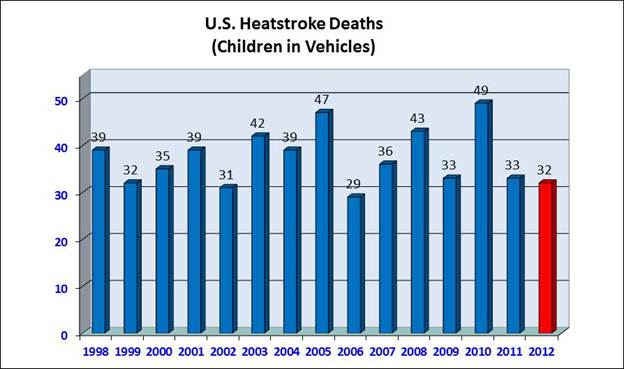
Each year, dozens of children and untold numbers
of pets left in parked vehicles die from
hyperthermia. Hyperthermia is an acute condition
that occurs when the body absorbs more heat than it
can handle. Hyperthermia can occur even on a mild
day. Studies have shown that the temperature inside
a parked vehicle can rapidly rise to a dangerous
level for children, pets and even adults. Leaving
the windows slightly open does not significantly
decrease the heating rate. The effects can be more
severe on children because their bodies warm at a
faster rate than adults.
Courtesy of San Francisco State
University. Use of this graph does not imply NWS
endorsement of services provided by San Francisco
State University.
How Fast Can the Sun Heat a Car?
The sun's shortwave radiation (yellow in figure
below) heats objects that it strikes. For example,
a dark dashboard or seat can easily reach
temperatures in the range of 180 to over 200°F.
These objects (e.g., dashboard, steering wheel,
child seat) heat the adjacent air by conduction and
convection and also give off longwave radiation (red
in figure below) which is very efficient at warming
the air trapped inside a vehicle.
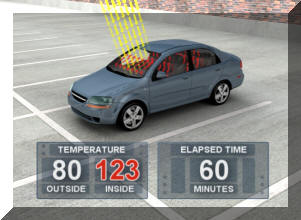
Shown below are time lapse photos of thermometer
readings in a car over a period of less than an
hour. As the animation shows, in just over 2 minutes
the car went from a safe temperature to an unsafe
temperature of 94.3°F. This demonstration shows just
how quickly a vehicle can become a death trap for a
child.
Objects Heated by the Sun
Warm Vehicle's Air
CLICK HERE FOR ANIMATION (700K)
(
Hi-Res ~ 2.5 mb.WMV file)
Individual Frames:
0 min,
10 min,
20 min,
30 min,
40 min,
50 min,
60 min
Animation Courtesy of General Motors and San
Francisco State University. Use of this animation
does not imply NWS endorsement of services provided
by General Motors and San Francisco State
University.
Hyperthermia deaths aren't confined to summer
months. They also happen during the spring and fall.
Below are some examples.
The atmosphere and the windows of a car are
relatively transparent to the sun’s shortwave
radiation yellow in figure below) and are warmed
little. This shortwave energy, however, does heat
objects it strikes. For example, a dark dashboard or
seat can easily reach temperatures in the range of
180°F to more than 200°F. These objects, e.g.,
dashboard, steering wheel, childseat, heat the
adjacent air by conduction and convection and give
off longwave radiation (infrared), which efficiently
warms the air trapped inside a vehicle.
Learn more about excessive heat and cars.
Vehicle Related Heat Deaths
- Honolulu, HI, March 07, 2007:
A 3-year-old girl died when the father left her
in a child seat for 1.5 hours while he visited
friends in a Waikiki apartment building. The
outside temperature was only 81 degrees.
- North Augusta, SC, April 2006:
A mother left her a 15-month-old son in a car.
He was in a car for 9 hours while his mom went
to work. She is now serving a 20-year prison
sentence.
- Greenville, TX, December 01, 2012:
A 6-month-old boy died after being left in a car
for more than 2 hours by his mother. She was
charged with murder. The temperature rose to an
unseasonably warm 81 degrees on
that day.
- Adults are in danger too.
On July 12, 2001, a man died of heat stroke
after falling asleep in his car with the windows
rolled up in the parking lot of a supermarket in
Hinds County, MS.
Safety Tips for Concerning Children
- Make sure your child's safety seat
and safety belt buckles aren't too hot
before securing your child in a safety restraint
system, especially when your car has been parked
in the heat.
- Never leave your child
unattended in a vehicle, even with the windows
down.
- Teach children not to play
in, on, or around cars.
- Always lock car doors and
trunks--even at home--and keep keys out of
children's reach.
- Always make sure all children have
left the car when you reach your
destination. Don't leave sleeping infants in the
car ever
|
Downloadable Child Vehicular Heat Stroke
Prevention Logos
Safety Tips for Adults
-
 Slow
down. Reduce, eliminate or reschedule
strenuous activities until the coolest time of
the day. Children, seniors and anyone with
health problems should stay in the coolest
available place, not necessarily indoors. Slow
down. Reduce, eliminate or reschedule
strenuous activities until the coolest time of
the day. Children, seniors and anyone with
health problems should stay in the coolest
available place, not necessarily indoors.
- Dress for summer. Wear
lightweight, light-colored clothing to reflect
heat and sunlight.
- Put less fuel on your inner fires.
Foods, like meat and other proteins that
increase metabolic heat production also increase
water loss.
- Drink plenty of water, non-alcoholic
and decaffeinated fluids. Your body
needs water to keep cool. Drink plenty of fluids
even if you don't feel thirsty. Persons who have
epilepsy or heart, kidney or liver disease, are
on fluid restrictive diets or have a problem
with fluid retention should consult a physician
before increasing their consumption of fluids.
Do not drink alcoholic beverages and
limit caffeinated beverages.
- During excessive heat periods, spend
more time in air-conditioned places.
Air conditioning in homes and other buildings
markedly reduces danger from the heat. If you
cannot afford an air conditioner, go to a
library, store or other location with air
conditioning for part of the day.
- Don't get too much sun.
Sunburn reduces your body's ability to dissipate
heat.
- Do not take salt tablets unless
specified by a physician.
Preparing for and Responding to Excessive
This site was last updated
Saturday, December 31, 2022 11:01:36 AM By: Barney Paytes III ©® |


