 |
Tornado Scale |
Enhanced Fujita Scale
Developed in 1971 by Tetsuya "Ted" Fujita (1920 - 1998) "Mr. Tornado" of the University of Chicago
The Fujita Scale is based on structural strength and engineering research done by Ted Fujita and a host of others. This research created the Fujita scale as a measurement of a tornadoes strength or intensity. Simply put, how intense would a wind have to be to move a cardboard box or to move bricks? One questions to ask would be: How fast or intense would the winds have to be to knock over a brick wall,? Obviously those winds would be significant. Through extensive research the Fujita Scale was developed based on damage, not wind speeds. Based on the extent of this damage conclusions are drawn as to what the winds would likely have to be to cause that type of damage. Since two wooden structured homes can be vastly different in quality and strength, there can be some misleading conclusions from the damage. Because of this and other overly general conclusions, storm researchers came up with the Enhanced Fujita scale to better reflect a tornado’s strength. Below is the new Enhanced Fujita scale started February 2007. |

Enhanced F Scale Damage Indicators | NUMBER (Details Linked) | DAMAGE INDICATOR | ABBREVIATION | | 1 | Small barns, farm outbuildings | SBO | | 2 | One- or two-family residences | FR12 | | 3 | Single-wide mobile home (MHSW) | MHSW | | 4 | Double-wide mobile home | MHDW | | 5 | Apt, condo, townhouse (3 stories or less) | ACT | | 6 | Motel | M | | 7 | Masonry apt. or motel | MAM | | 8 | Small retail bldg. (fast food) | SRB | | 9 | Small professional (doctor office, branch bank) | SPB | | 10 | Strip mall | SM | | 11 | Large shopping mall | LSM | | 12 | Large, isolated ("big box") retail bldg. | LIRB | | 13 | Automobile showroom | ASR | | 14 | Automotive service building | ASB | | 15 | School - 1-story elementary (interior or exterior halls) | ES | | 16 | School - jr. or sr. high school | JHSH | | 17 | Low-rise (1-4 story) bldg. | LRB | | 18 | Mid-rise (5-20 story) bldg. | MRB | | 19 | High-rise (over 20 stories) | HRB | | 20 | Institutional bldg. (hospital, govt. or university) | IB | | 21 | Metal building system | MBS | | 22 | Service station canopy | SSC | | 23 | Warehouse (tilt-up walls or heavy timber) | WHB | | 24 | Transmission line tower | TLT | | 25 | Free-standing tower | FST | | 26 | Free standing pole (light, flag, luminary) | FSP | | 27 | Tree - hardwood | TH | | 28 | Tree - softwood | TS |
Enhanced Fujita Scale article has been completed by the Wind Science and Engineering Center at Texas Tech University.
Click here for the (pdf) document that details how the new scale is derived. Discussed in the article is the need for revising the current rating system used that was created by Dr. Ted Fujita.
Thanks to
http://www.spc.noaa.gov and
http://www.wind.ttu.edu for the new information.
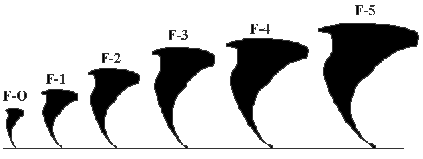
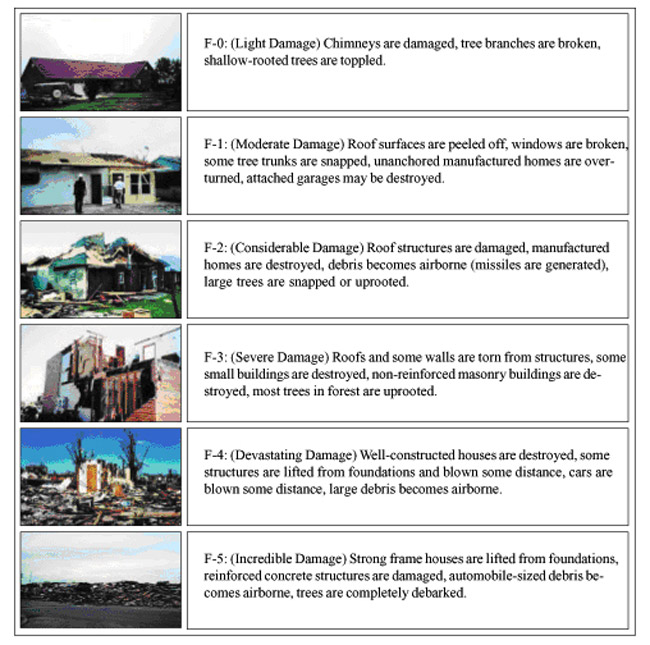 OLD FUJITA SCALE BELOW | Intensity Phrase | Type of Tornado ........ | Estimated Wind speeds |
F0...................Gale tornado.............. winds of 40-70 mph
Some damage to chimneys; break branches off trees, pushes over shallow- rooted trees-, damages sign boards. | Fl................... Moderate tornado.........winds of 73-112 mph
The lower limit is the beginning of hurricane wind speed- peels surface off roofs; mobile homes destroyed. | F2...................Significant tornado........winds of 113-157 mph
Considerable damage. Roofs torn off frame houses- mobile homes demolished; boxcars pushed over; larger trees snapped or uprooted-, light object missiles generated. | F3...................Severe tornado.............winds of 158-206 mph
Roof and some wall torn off well constructed houses trains overturned; most trees in forest uprooted | F4...................Devastating tornado........winds of 207-260 mph
Well-constructed houses leveled-, structures with weak foundations blown off
some distance; cars thrown and large missiles generated. | F5..................Incredible tornado...........winds of 261-318 mph
Strong frame houses lifted off foundations and carried considerable distances to disintegrate- automobile sized missiles fly in excess of 100 meters; trees debarked; steel reinforced concrete structures badly damaged. | F6.................Inconceivable.................winds of 319-379 mph
These winds are very unlikely. The small area of damage they might produce would probably not be recognizable along with the mess produced by F4 and F5 wind that would surround the F6 winds. Missiles, such as cars and refrigerators would do serious secondary damage that could not be directly identified as F6 |
This site was last updated
Saturday, December 31, 2022 11:01:36 AM By: Barney Paytes III ©® |